
A conventional air conditioner cools a room by expelling its heat outside. This is achieved through an energy-consuming compressor and a refrigerant gas whose European regulations specifically regulate its gradual elimination.
In its case, adiabatic cooling proceeds differently. In fact, it cools the air by relying on a phenomenon that desert civilizations already exploited with clay pots that were porous. ClimnTech We have taken this principle and turned it into an industrial solution. A technology designed to reconcile the comfort of teams with a serious environmental impact.
Adiabatic cooling
A physical principle…
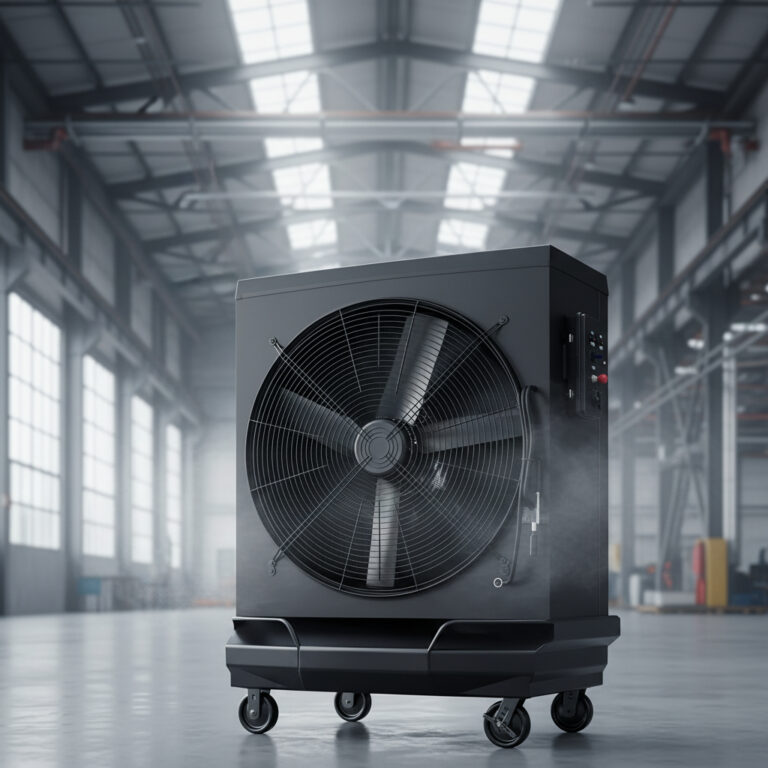
The phenomenon is based on the evaporation of water. A fan passes ambient air through a constantly humidified alveolate medium. To turn into steam, the water draws its energy directly from the air it passes through. This means that the air comes out cooler, without any external energy having been injected to produce that cold. Except, of course, the fan’s energy.
… simple and old-fashioned
We talk about «adiabatic» cooling precisely because the total energy of the air remains constant. In fact, the sensible energy simply transforms into latent energy in the form of water vapor. No compressor, no refrigerant, no pressurized gas. In other words, only air and water, brought to motion.
Why this method meets a regulatory need, not just an ecological one
Increasingly strict regulations
Conventional air conditioning relies on fluorinated gases (HFCs), the reduction of which is regulated by the European F-Gas regulation with quotas tightening every year. In practice, this translates into a mechanical increase in the cost of these fluids and increasing constraints on their maintenance and recycling at the end of their life cycle. A company that invests today in air conditioning with a compressor therefore runs the risk of becoming dependent on an increasingly restricted resource.
The adiabatic solution for the future
Adiabatic cooling is completely free from this constraint. Without a refrigerant fluid, it mechanically escapes this regulation and its effects on future operating costs. This is an argument for resilience as well as an ecological argument.
What adiabatic cooling actually changes for your employees
On the energy front, the electric consumption of a adiabatic cooler remains close to that of a simple fan. However, it has a reduced consumption that can exceed 80 % compared to conventional air conditioning. But the impact is not limited to the energy bill.
The produced air maintains controlled humidity, unlike the dry and sometimes irritating air of a conventional air conditioning system. This promotes better health and well-being. thermal comfort and the respiratory health of teams in workstations exposed to heat. In environments where employees wear mandatory protective equipment, this difference is directly felt in thermal fatigue at the end of the day.
You want to assess the impact of a air cooler Is it adiabatic on your site? Talk with a ClimateTech expert for a preliminary diagnosis.
Legitimate objections, and what they deserve in return
Two criticisms come up regularly, and they are not unfounded.
1. Humidity
The first concerns humidity. In a climate already very humid, the air can no longer absorb much additional water. The resulting temperature difference is then reduced. This is a real physical limit, which’a serious design studio should be integrated into the design process rather than minimized.
2. Standing water
The second aspect concerns the maintenance of stagnant water, which is sometimes cited as a health risk. A well-designed system with continuous circulation and appropriate water treatment eliminates this risk. In reality, this is a point of caution in the design, not a fatal flaw of the process itself. A supplier that claims the opposite lacks technical rigor.
Integrating adiabatic cooling into an environmental corporate approach
For a company committed to reducing its carbon footprint, replacing or complementing conventional air conditioning with an adiabatic solution has multiple effects at the same time.
First, the electrical consumption related to cooling. Then, exposure to regulated fluorinated gases. Finally, the technical maintenance associated with a refrigeration circuit.
It is a concrete, measurable lever to integrate into a carbon footprint or an CSR approach. Alongside this, of course, other actions on insulation or energy efficiency are also necessary. Industrial adiabatic air conditioning Developed by ClimnTech, it fits into this logic. Our industrial evaporative cooler It is designed for large volumes as well as for more targeted needs.
Want to go further with ClimnTech expertise? Contact us to discover our approach to bioclimatic cooling.
Adiabatic cooling is not a passing fad or a mere summer gadget. In short, it is a mature technology whose economic and environmental relevance is growing as regulations tighten the noose on conventional refrigerants. For a company, adopting it today is anticipating a constraint that will become structural tomorrow. And this by offering its teams immediate thermal comfort.
Frequently Asked Questions
Is adiabatic cooling really environmentally friendly?
Yes, it operates without a refrigerant fluid or compressor, with a very low electrical consumption. However, its environmental impact depends on water management, which must be optimized according to the climate and usage.
Why is the F-Gas regulation making this issue urgent for companies?
This European regulation gradually reduces the quotas of fluorinated gases used in conventional air conditioning, which increases their cost and complicates their long-term maintenance. Adiabatic cooling does not use any of these fluids.
Does adiabatic cooling work in a humid climate?
Its effectiveness decreases when the outdoor air is already loaded with moisture, as the evaporation of water becomes more difficult. Proper sizing to the local climate remains essential to anticipate this variation.
Is there a health risk associated with the water used in these systems?
No, provided that the system incorporates continuous circulation and an appropriate treatment of the water. This is a design criterion to be checked with the supplier, rather than an inherent defect in the technology.

 French
  English