
As soon as temperatures rise, the question of thermal comfort in the workshop arises. Two main families of solutions are available to you: classic air conditioning, well known, and adiabatic cooling, still too often unknown. However, for the vast majority of industrial environments, the choice is far from equivalent. ClimnTech experts explain why.
Two technologies, two philosophies
Traditional air conditioning relies on a compression thermodynamic cycle. In fact, a compressor compresses a refrigerant gas, which then expands to absorb heat from the ambient air. This process produces cold, but it also releases heat outside. Thus, it consumes a lot of electricity and requires a fixed installation with often heavy climate engineering work.
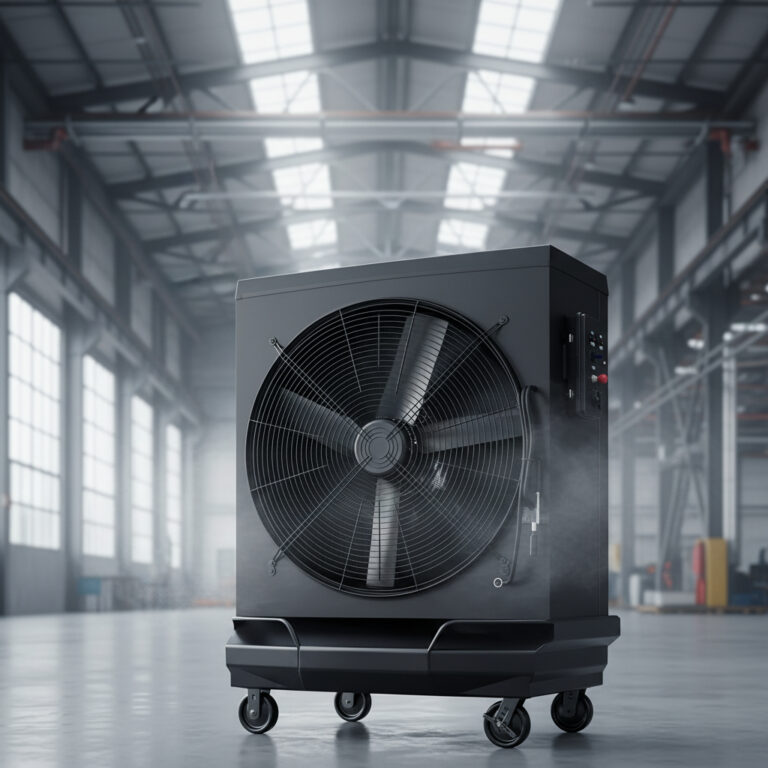
The adiabatic cooler, on the other hand, works on a radically different, and fundamentally simpler, principle. In fact, a fan draws in hot outdoor air and passes it through a constantly humidified honeycomb medium. As it passes through this panel, the air gives up its heat to allow water to evaporate. It then emerges cooled, naturally. In short: no refrigerant gas, no compressor, no construction work. Just air and water.
A significant energy consumption gap
This is the most compelling argument in favor of adiabatic cooling: it consumes up to 80 % less electricity than a conventional air conditioner. Whereas an industrial air conditioner requires several kilowatts to operate, an adiabatic cooler uses only the power of a fan motor.
So, in a context of sustainably rising energy costs, this operational economy profoundly changes the profitability calculation of a piece of equipment. The initial investment, significantly lower than that of a centralized installation, is quickly amortized.
Mobility: a decisive advantage for the workshop
Standard air conditioning assumes a fixed installation. It treats a global volume of air, whether or not it's an occupied space. In a workshop with localized workstations, high ceilings, or frequent openings, this approach conditions thousands of cubic meters of air... for the comfort of a single operator.
ClimnTech adiabatic coolers They are mounted on wheeled chassis. They deploy in minutes, without any work, and are positioned exactly where the operator needs them. Change of workstation, reorganization of the workshop, occasional intervention: the solution follows the people, not the building.
In short, this flexibility makes it an ideal solution for production workshops, logistics warehouses, storage areas, and even open or semi-open outdoor spaces. These are configurations where traditional air conditioning is often ineffective or impossible to install.
Concrete thermal performance
Adiabatic cooling lowers ambient temperature by 7°C to 12°C depending on atmospheric conditions. Its performance even increases with heat: the hotter and drier the air, the more powerful the evaporation, and the more pronounced the cooling effect.
As a point of reference: studies show that at temperatures as high as 29 °C, an operator’s productivity drops by 18 % and errors increase by 40 %. Bringing the temperature at the workstation down to an acceptable level is not just a matter of comfort. It is essential for performance and safety.
An unparalleled environmental record
Traditional air conditioning uses refrigerants with a considerable global warming potential. It also produces thermal discharge into the outside, which contributes to urban heat islands.
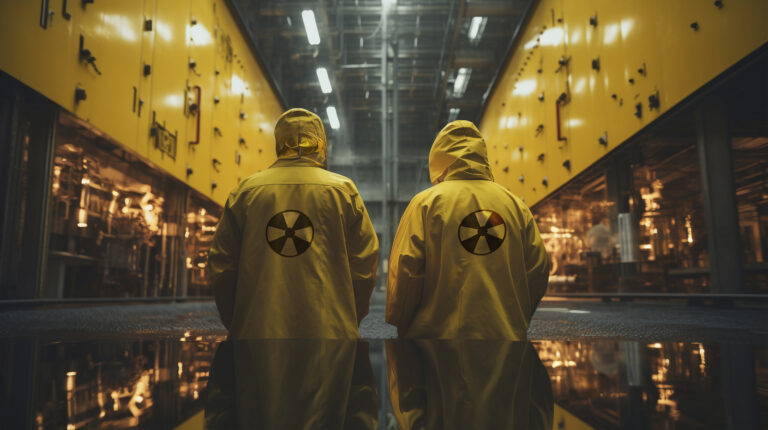
The adiabatic cooler, on the other hand, emits no polluting gases. In fact, it consumes water and electricity in very small quantities. It slightly humidifies the air, which constitutes (in the case of ClimnTech ATEX-certified equipmentan additional benefit. This slight humidification reduces static electricity and limits the risk of explosions in classified environments.
Are you equipping a workshop, warehouse, or production space? Request a quote from our experts
What classic air conditioning does best
Objectivity requires mentioning this. Compression air conditioning allows for precisely regulated temperature maintenance, independent of external humidity. Therefore, it is suitable for environments that demand strict temperature control. This is the case for computer rooms, pharmaceutical laboratories, and certain food production lines.
It is also more efficient in perfectly closed and airtight spaces, where one accepts conditioning a fixed volume and maintaining a narrow temperature range.
Comparative Summary Table
| Criterion | Adiabatic cooler | Classic air conditioning |
|---|---|---|
| Energy consumption | Very low (−80 %) | Raised |
| Installation | No work, mobile | Fixed, necessary work |
| Acquisition cost | Accessible | Raised |
| Interview | Simple (no compressor) | Complex (gas, compressor) |
| Open space efficiency | Excellent | None or very low |
| Carbon footprint | Minimal | Significant |
| Precise temperature control | No | Yes |
| ATEX zone compatibility | Yes (certified range) | Non-standard |
What choice for your workshop?
Does your workshop have any of these characteristics: large volumes, frequently open doors, localized workstations, ATEX constraints, operating budget to control? Then, an adiabatic cooler meets your needs with superior efficiency to traditional air conditioning. And this, at a much lower total cost.
Compression air conditioning remains relevant in very specific contexts. For the majority of industrial workshops, warehouses, and production areas, adiabatic cooling has become the standard.
Do you want a sizing adapted to your site?


 French
  English