
A trade show running at full capacity? Crowded aisles right from opening? Lighting spots heating up continuously? The HVAC of an event cannot be managed like that of an office building. Heating, ventilation, air conditioning: the three pillars remain the same, but the constraints change radically. ClimnTech equips trade show organizers, convention centers, and conference venues with technology that precisely meets these constraints. Discover adiabatic cooling.
HVAC, a specific challenge for trade shows, conventions, and large gatherings
A convention center has neither the same operating hours nor the same volume as a traditional office. Visitor numbers vary greatly depending on the time slots and the heat generated by the attendees. Furthermore, technical equipment accumulates in halls that are often glass-walled, and the installation of a fixed HVAC system is almost never feasible for an event lasting just a few days.
Even so, the heating, ventilation, and air conditioning must still meet the expectations of a professional audience. Otherwise, it is the visitor experience, and the image of the event, that suffers.
Adiabatic cooling, an HVAC building block in its own right
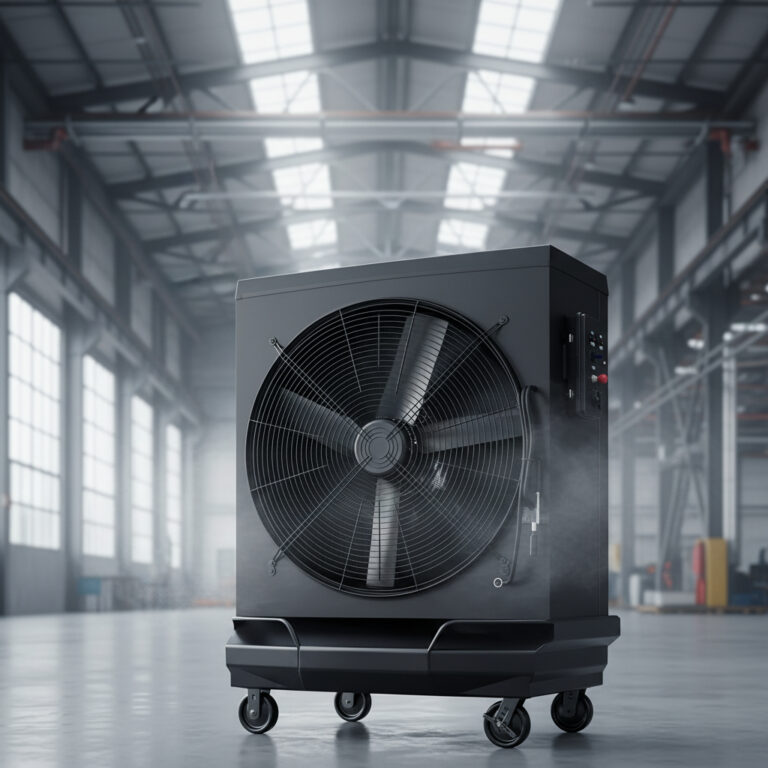
Unlike a compressor-based air conditioner, an evaporative cooler produces cool air through the natural evaporation of water. Here, ambient air passes through a moistened media, releases its heat, and then emerges cooled and slightly humidified. This approach integrates perfectly into an overall HVAC logic, alongside the Industrial adiabatic air conditioning already developed by ClimnTech for large volumes. It does not necessarily replace an existing ventilation system, it complements it. And it does so by providing a targeted temperature drop where the public is concentrated.
7 reasons to choose the ClimnTech evaporative cooler for your events
1. Measurable thermal comfort, even in an open configuration
A marquee, tent or hall with constantly opening doors makes conventional air conditioning inefficient. The air cooler adiabatic maintains its performance under these conditions, where a compressor system quickly loses efficiency.
2. Installation in just a few minutes, no renovation work required
Mounted on a wheeled chassis, the unit is positioned directly on site. An electrical connection and a water supply are all that is needed: no major structural work is required, and no dedicated HVAC contractor needs to be mobilized in advance.
3. Discretion compatible with the visitor experience
The noise level remains controlled and the device visually integrates into a stand or aisle without disrupting the event's scenography.
4. Energy sobriety that lightens the technical budget
Power consumption is limited to that of a fan, with savings that can exceed 80 % compared to conventional air conditioning. This is a significant consideration for events where energy costs already account for a large portion of the technical budget.
5. Preserved air quality
The air produced is not dried out, unlike certain air conditioning systems that increase respiratory discomfort in crowded spaces. The controlled humidity level contributes to the thermal comfort general public over the duration of the event.
6. Complete flexibility, adjustable based on crowd levels
The device moves during the event to follow high-density areas—reception, main aisles, conference spaces—without tying down a technical team.
7. The same technology available year-round
Beyond summer cooling, the ClimnTech range relies on industrial adiabatic fans versatile, designed to cover multiple types of events and seasons, from the spring trade show to the back-to-school congress.
Are you organizing a trade show or a convention in the coming months? Talk with a ClimateTech expert to size your event HVAC solution.
How to integrate adiabatic cooling into your event HVAC strategy
The sizing depends on several factors: the hall’s floor area, ceiling height, expected outdoor humidity, and projected crowd density. A 2,000 m² enclosed space requires a different configuration than a tent open on three sides. The ClimnTech team works with organizers in the lead-up to the event to perform these calculations, determine the number of units needed, and plan their placement on the floor plan, in alignment with the ventilation system already provided by the organizer or the venue.
One technical caveat is worth noting: the efficiency of evaporative cooling varies depending on ambient humidity. At an event held in a particularly humid climate, the temperature drop achieved will be less pronounced than in dry air, even though the continuous airflow maintains a perceptible cooling effect for visitors. This is a parameter to integrate during the preparation phase rather than discover on the big day.
Not sure what size is right for your space? Contact ClimnTech for a personalized study before your next event.
Event HVAC is therefore not just a matter of renting mobile air conditioners at the last minute. It is an aspect that must be anticipated just like scenography or security, using a technology (evaporative cooling) that ticks the boxes specific to the sector: speed, mobility, energy efficiency, and air quality, without the constraints of a heavy installation. To learn more about ClimnTech's expertise, the page About present the company's positioning and certifications.
Frequently Asked Questions
Is evaporative cooling part of HVAC?
Yes, this is a full-fledged air treatment technique, complementary to traditional air conditioning, which integrates into an overall HVAC strategy, particularly for temporary spaces or large volumes.
How long does it take to equip a living room with an evaporative cooler?
The device is operational within minutes of delivery: an electrical connection and a water top-up are all that is required, with no prior work needed.
Does evaporative cooling work in an open marquee?
Yes, and it is even a context where it retains an advantage over traditional air conditioning, which is less efficient in open configurations or with a constant flow of visitors.
How does an event affect energy costs?
The power consumption remains close to that of a simple fan, with savings that can exceed 80 % compared to conventional air conditioning, a direct advantage for the technical budget of a trade show or a convention.
 French
  English