
A workshop at 36°C under a roof in the middle of summer? A production line that cannot be stopped? A traditional air conditioning bill that would make any technical director wince? These are all contexts in which the evaporative cooler has carved out a place for itself in the industrial sector. The principle appeals for its simplicity (water, air, no refrigerant gas), but its efficiency depends on specific conditions that many product spec sheets gloss over. This is also the case for certain constraints that complicate its installation in the most sensitive environments. ClimnTech shed light on the subject.
The physical principle, without shortcut
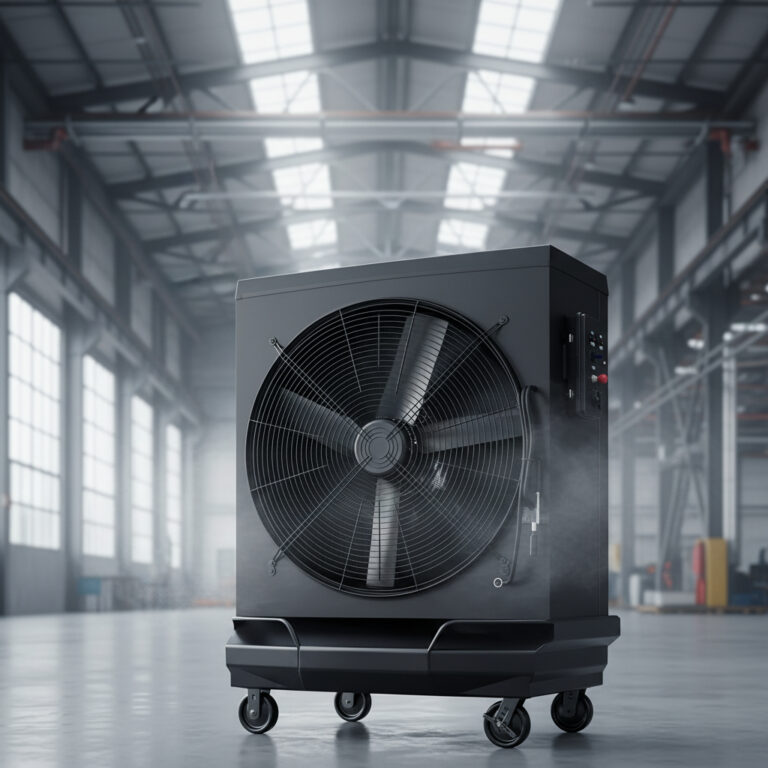
An evaporative cooler draws in ambient air and passes it through an evaporative media (a honeycomb panel or porous pad) kept constantly moist by a closed-circuit pump. As the water evaporates upon contact with the warm air, it absorbs part of its sensible heat in the form of latent heat of vaporization. The air thus emerges cooler, but also slightly more humid, before being propelled into the space to be treated by a centrifugal or axial fan, depending on the desired capacity.
The temperature drop achieved is generally between 5 and 12°C. This difference depends directly on the temperature and humidity of the incoming air. At a site where outdoor air reaches 35°C with moderate humidity, supply air at 22-24°C remains entirely achievable. This variability, inherent to the process, deserves to be explained before purchase rather than discovered after installation.
What the process really saves
The energy argument remains the strongest. Without a compressor or refrigerant, an evaporative cooler consumes between 5 and 10 times less electricity than a direct expansion air conditioner of equivalent capacity. For an industrial hall operating for several months a year during hot periods, this difference translates into thousands of euros saved on the energy bill, not to mention the absence of refrigerants to monitor or F-Gas regulations to comply with.
The other advantage, which is less emphasized, relates to the air renewal required by the system's operation. Unlike a closed-loop air conditioning, an adiabatic cooler operates with openings (doors, loading docks, roof vents) which mechanically improves indoor air quality. All while continuously evacuating dust, vapors, and process odors.
The limits that are never detailed enough
The system becomes significantly less effective when the ambient humidity exceeds 60–65 %. This is because the air is already close to its saturation point, evaporation slows down, and the cooling effect becomes negligible. A site located by the sea, or an operation that generates humidity itself—such as certain food processing industries—must therefore take this factor into account before choosing this method over conventional air conditioning.
The second point, often minimized, concerns the air renewal necessary for the proper functioning of the system, on the order of fifteen to twenty volume changes per hour according to specialized installers. A totally closed building, without the possibility of evacuating the blown-in humid air, will never allow the performance advertised on the technical datasheet to be achieved. Here, humidity stagnates, and comfort degrades instead of improving.
The evaporative cooler is therefore not a universal solution, but a very effective tool in its field of application: large semi-open volumes, workshops with outside access, or even stable and breeding area.

The special case of the ATEX zone
On a ATEX-classified site, the question does not stop at the choice between adiabatic and conventional air conditioning. A standard cooler includes an electric pump, a motor, and often a control board. These are all components capable of generating a hot spot or a spark, which are incompatible with an atmosphere where combustible gases, vapors, or dust can mix with the air.
The installation of such a device in Zone 1, 2, 21 or 22 therefore requires a specifically ATEX-certified model, in which every electrical component meets a type of protection adapted to the site's risk category. This is a point that most generalist manufacturers of evaporative coolers do not address, simply because their standard range is not designed for these environments.
This is precisely the field in which ClimnTech has specialized: mobile evaporative cooling solutions, certified for explosion-risk zones, designed for industrial workstations rather than commercial use.
If your workshop is ATEX-classified and heat becomes a recurring problem during the hot season, a quick site assessment can determine in just a few days which configuration is truly suitable. Call us.
Apart from the ignition risk, the antistatic benefit of mild air humidification makes the adiabatic principle a relevant option in an ATEX zone. Provided that the device itself is certified to be used there, of course.
How to choose without making a mistake on the sizing
The volume to be treated remains the primary criterion, but rarely the sole determinant. The average humidity of the site directly conditions the expected efficiency, as does the actual feasibility of ensuring the air renewal necessary for the system to operate. The need for mobility also comes into play at sites where high-heat workstations shift according to production. Likewise, the potential ATEX classification of the site immediately restricts the choice to certified devices.
Poorly assessed sizing remains the primary cause of dissatisfaction with this type of equipment. Our teams conduct an on-site thermal audit before making any recommendation, precisely to avoid this pitfall. Please feel free to Contact us to evaluate the configuration suited for your workshop.
Within its field of application, the evaporative cooler remains one of the most cost-effective solutions on the market for treating large industrial volumes. Understanding its limitations as much as its advantages avoids disappointments. Moreover, this makes it possible, where appropriate, to point toward a complementary or certified solution rather than a device unsuited to the actual use of the site.
Frequently Asked Questions
Does an adiabatic fan work in a closed indoor space?
Its effectiveness depends on sufficient air renewal. In a completely enclosed building, without the evacuation of the supplied humid air, performance drops significantly compared to the conditions of a semi-open space.
What is the difference between a fan and a traditional air conditioner?
The conventional air conditioner cools via a closed-circuit refrigeration cycle and precisely regulates the temperature. The evaporative cooler cools by water evaporation, consumes much less energy, but requires constant air renewal and remains less effective in very humid environments.
Can an evaporative cooler be installed in an ATEX zone?
Yes, provided you use a model specifically certified ATEX. A standard device contains electrical components that are not suitable for an explosive atmosphere and represents an ignition risk.
What energy savings can be expected compared to traditional air conditioning?
Generally between 5 and 10 times less electricity consumption, with the exact difference depending on the installed capacity and the site's annual operating time.
At what humidity level does the system lose efficiency?
Above 60 to 65 % of ambient humidity, the cooling effect becomes significantly more limited, as the air is already close to its saturation point.

 French
  English