
Choosing an adiabatic air conditioner for a conventional workshop and choosing one for an ATEX zone are two exercises that have almost nothing in common. In fact, the former boils down to calculating the volume and airflow. The latter involves certifying the device, its compatibility with the site’s zoning, and the safety of all those working nearby. ClimnTech has built its expertise on this specific requirement. Where most suppliers of adiabatic air conditioning stop at the threshold of the risk zone.
Why the ATEX zone changes everything for an adiabatic air conditioner
What the ATEX zone requires of air conditioning equipment
One ATEX zone imposes that all present equipment be certified for the zone class concerned. That is, Zone 0, 1 or 2 for flammable gases and vapours, Zone 20, 21 or 22 for combustible dusts. Thus, an adiabatic air conditioner that is not certified, even if it is efficient, cannot legally be installed in these environments. And this is regardless of the quality of its manufacture.
The limits of a standard non-certified adiabatic air conditioner
A conventional adiabatic air conditioner incorporates an electric motor, a water circulation pump and sometimes electronic control electronics. Each of these components represents a potential source of ignition. Especially if it has not been specifically designed and certified to operate in an explosive atmosphere. This is precisely what the majority of generalist manufacturers do not offer. Often, due to a lack of internal ATEX expertise.
6 advantages of the ClimnTech adiabatic air conditioner in ATEX zones
A physical principle that reduces the risk of electrostatic discharge
Unlike a dry air conditioner, the adiabatic air conditioner slightly humidifies the air by cooling it. This controlled humidity level limits the accumulation of’static electricity. A risk factor directly related to explosive atmospheres. This is a structural advantage of the process, not an option added at a later stage.
A certified seal on the exact zone class
The ClimnTech adiabatic air conditioners are Zone 1 and Zone 2 certified (marking II 2G IIB T4 Gb), with an IECEx version. This facilitates their deployment in international sites. This granularity of certification avoids over-equipping a Zone 2 with equipment designed for a Zone 1. A choice that would be unnecessary in terms of cost.
An electrical consumption compatible with the power constraints in a classified area
On a site where every electrical circuit is audited, an adiabatic air conditioner has a concrete advantage. Indeed, its consumption remains close to that of a simple fan. However, with savings that can exceed 80 % compared to a compressor air conditioner. This simplifies the electrical integration of the project, which is often constrained in these sites.
A mobile installation, without heavy intervention in a high-risk area
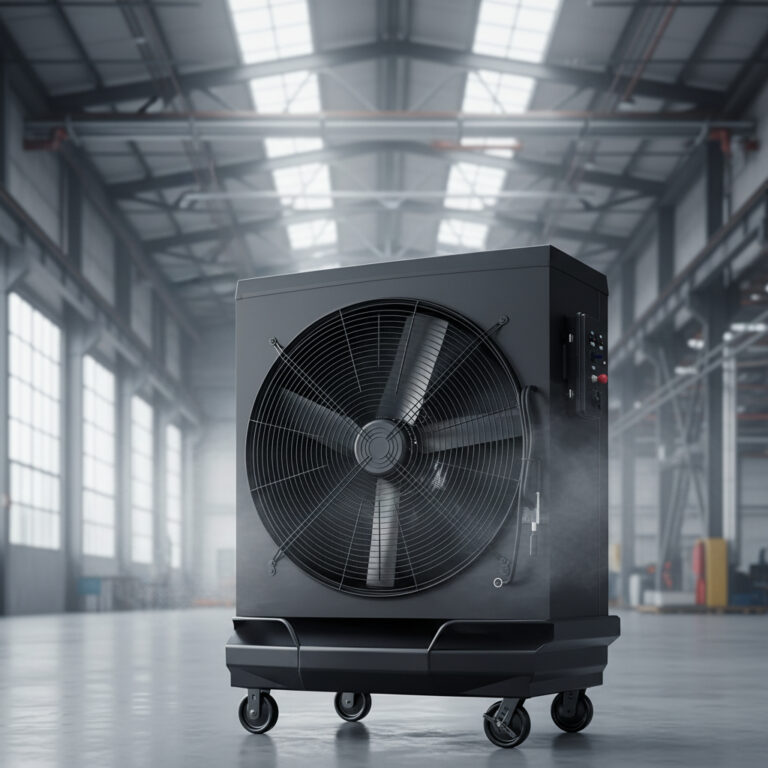
Mounted on a wheeled chassis, the device is positioned without the need for drilling or major construction work, a valuable quality when any intervention in a classified area must be planned, secured, and sometimes subject to a work permit.
A non-dried air, valuable in personal protective equipment
In a workplace where operators already wear full protective suits and mandatory protective equipment, a thermal comfort preserved (without dry air or a feeling of respiratory discomfort) actually changes alertness at the end of the shift.
An accompaniment that goes beyond the delivery of the device
An adiabatic air conditioner, even if perfectly certified, remains a safety equipment that must be operated correctly. ClimnTech assists its customers with training and support. ATEX training courses Dedicated to ensuring that compliance remains effective long after installation has taken place.
Does your site require a certified adiabatic air conditioner for a specific area? Let's talk about it with an expert from ClimnTech.
Installing an adiabatic air conditioner in an ATEX zone: the ClimnTech method
The sizing always begins with a precise reading of the existing zoning: zone class, gas group (IIA, IIB or IIC), temperature class. It is this analysis that determines the appropriate adiabatic air conditioning model. Even before considering the volume to be treated or the required air flow. On sites where other equipment requires an ATEX compliance check in parallel, ClimnTech relies on its expertise. Experience in refreshing operators in the ATEX zone. Thus, we offer you a coherent response, designed for the entire site rather than for a single isolated post.
Need a diagnosis before your installation project? Contact ClimnTech to evaluate the solution that is suitable for your zoning.
A well-chosen adiabatic air conditioner for an ATEX zone is therefore never limited to a choice of thermal performance alone. It is a decision that involves the safety of the site as well as the comfort of the teams, and one that deserves an operator capable of meeting both requirements simultaneously.
Frequently Asked Questions
Can all adiabatic air conditioners be installed in an ATEX zone?
No. Only models specifically certified for the relevant zone class (Zone 1, Zone 2, etc.) can be deployed there legally, regardless of the overall quality of the manufacturer.
Does an adiabatic air conditioner increase the risk of static electricity in an ATEX zone?
No, it’s the opposite. The slight humidification of the air during the adiabatic process helps reduce the accumulation of static electricity, a risk factor in explosive atmospheres.
What is the difference between Zone 1 and Zone 2 certification for an adiabatic air conditioner?
Zone 1 refers to places where an explosive atmosphere is likely to form occasionally during normal operation; Zone 2 refers to places where it only forms accidentally and briefly. Certified equipment must correspond exactly to the area where it will be installed.
Should teams be trained after the installation of an adiabatic air conditioner in an ATEX zone?
This is not a mandatory regulatory requirement per device, but it is highly recommended to ensure that the operation and maintenance of the equipment comply with ATEX compliance over time.

 French
 English
