
A targeted
and economical heat
Our innovation offers industrial manufacturers unprecedented thermal control. Our industrial far-infrared heating systems combine energy efficiency with instant effectiveness, even in the most demanding conditions.
Our solutions for
infrared heating
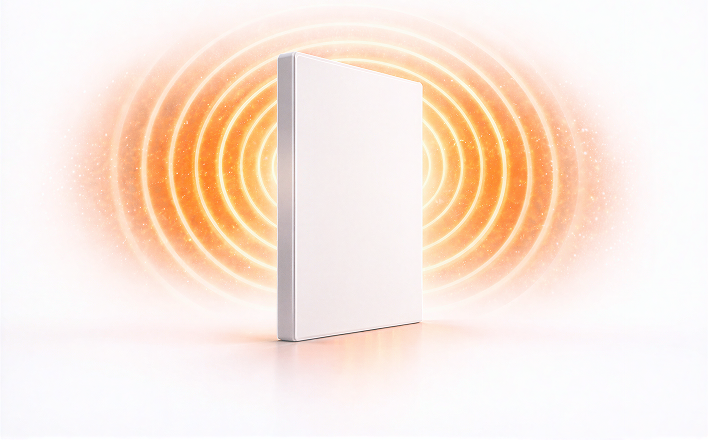
In large industrial spaces where traditional convection heating is ineffective and costly, far-infrared heating emerges as the optimal solution. This technology revolutionizes thermal comfort in professional settings by shifting the energy paradigm. In reality, it's no longer about heating unstable air masses, but about transferring heat directly to bodies and structures.
An industrial far-infrared heater
Expertise ClimnTech extends to the design of mobile heating devices for explosive atmospheres. We supply robust, skid-mounted, transportable heating units. All are capable of ensuring operator safety in the heart of hazardous areas, regardless of your industry.
Our devices are certified Zone 1 ATEX II 2G IIB T4 Gb. As such, they guarantee worry-free operation where any other electric heating system would be prohibited or very costly.
The mobility of our equipment allows for immediate implementation as close as possible to workstations. We thus optimize every kilowatt consumed.
The ecological solution
for industrial heating
Far-infrared (FIR) heating is a bioclimatic technology that reproduces the sun's natural radiation. It is a long wave that does not use air as a transfer medium, but directly heats organic matter and solid bodies it encounters. In conventional industrial heating, hot air rises (stratification phenomenon) and is lost near ceilings; with FIR, heat stays where the target is located.
3 benefits of a radiator
far infrared
1. Energetic efficiency
By eliminating heat loss associated with heating air volumes, our devices are up to ten times less energy-intensive than convection systems.
3. Instantaneous thermal comfort
Heat is felt as soon as it is turned on, freeing your teams from any preheating time.
3. No dust agitation
Unlike air heaters, this radiation does not cause dust to circulate. It thus ensures the health and cleanliness of workstations.
How does far-infrared heating work?
The device uses carbon or ceramic emitters. Heated to a maximum temperature of 60°C, these emit invisible electromagnetic radiation within the long-wave infrared spectrum.
It should also be noted that FIR is recognized as beneficial for the health of your employees and colleagues.
Let's discuss your project
For the comfort of a logistics sorting station or to heat an operator in a refining zone, we engineer our solutions according to your specific business needs.
The ClimnTech Advantage: 100 % solutions that can be customized!
Frequently Asked Questions
Frequently Asked Questions
What are the downsides to infrared heating?
Radiant heating requires a direct «line of sight» between the emitter and the target. If a massive obstacle is placed between the infrared radiator and the operator, the heating effect will be masked (thermal shadow). This is why placement must be strategically studied.
In an industrial environment, which is better, infrared or far-infrared?
Far-infrared is ideal in industry because it combines ATEX comfort and safety. It operates with moderate surface temperatures. This feature is crucial for respecting temperature classes (T-Class) and preventing any risk of self-ignition in sensitive areas, while offering gentle warmth to workers.
Does a far-infrared heater consume a lot of energy?
Quite the contrary. It is one of the most economical ATEX electric heating modes on the market. Since it doesn't aim to raise the temperature of thousands of cubic meters of air, but focuses on the few cubic meters surrounding the operator, the installed power required is drastically reduced.
Where to place an industrial far-infrared heater?
The ideal placement is in front of or to the side of the workstation, at a distance of 2 to 3 meters from the user. For storage environments, they can be fixed on rack structures or remain mobile on their cabinet supports to adapt to evolving order picking areas.
 French
  English